We invite you to take part in a series of our open lectures on psychoanalytic work with individuals, children, teenagers and couples and families.
We have invited speakers from all over the world to share with us their knowledge and clinical experience.
As it is customary for psychoanalytical speeches to be read out, our speakers will read out their lectures. After the lecture, you are welcome to take part in a discussion, which will be interpreted live. The whole event is scheduled for 1.5 hours.
You can find detailed information regarding each lecture below. Come and join us!
Registration:
Please fill in the registration form. After completing the registration form you are redirected to the payment.
Fee: 150 PLN (ca 35 EUR)
You will receive the link to the event afterwards. If you do not receive the link, please check your spam folder in your email box or contact us at: wplaty@ptpp.pl
2026
January 26th, 8.00 – 9.30 p.m. CET
Mary Morgan “The fate of love in some forms of intimate relating”
To participate in the lecture go to
You can register untill January 26th
March 30th, 8.00 – 9.30 p.m. CET
Crictine Calarasanu “Mother will you unlock me? The impossible separation in couples and famielies”
To participate in the lecture go to
Yo can register untill March 30th
Cristina Călărășanu was trained in relational psychoanalysis in Romania and in link psychoanalysis in France. She works in private practice in Bucharest, Romania and does also teaching and supervision.
She is the EFPP Vicepresident and chair of the Couple and Family Section, International Association for Couple and Family Psychoanalysis (IACFP) Scientific Secretary, member of the French Society for Psychoanalytic Family Therapy (SFTFP) and Founder Member of the Romanian Association for the Psychoanalysis of Group and Family Links. She is also EFPP Book Series Editor in Chief.
Christina is the author of articles and book chapters as well as a translator of books on psychoanalysis.
Mother, will you unlock me? The impossible separation in couples and families.
In this paper, I propose to address the way in which family links are constructed and, in particular, the way in which narcissistic links are articulated with libidinal links, which within a family are permanently intertwined. Their balanced cohabitation contributes to the solid construction of family relationships. A. Eiguer (1984) defines the « family self » as the image that the family, as a group, has of itself. Family narcissism allows each member of the family to construct their own narcissism by relying on their links for belonging. When narcissistic and libidinal links are imbalanced, this corresponds to family fragility. We can observe that the functioning which predominates within narcissistic links in a family produces a tendency toward undifferentiation of links and great suffering.
My theoretical reference in this presentation is related to the link theory (teoria del vinculo) as it was conceptualized by the Argentinian-French school and in particular following the link concept as described by Enrique Pichon Riviere, “a complex structure that includes subject, object and their mutual interaction through communication and learning.”
2025
November 24th, 8.00 – 9.30 p.m. CET
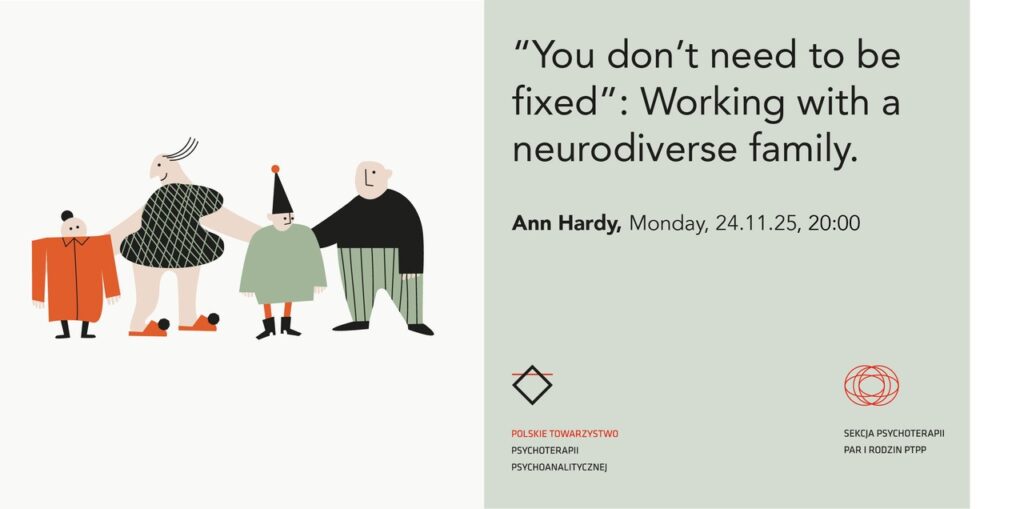
Ann Hardy “You don’t need to be fixed”: working with a neurodiverse family
To participate in the lecture go to
You can register untill November 24th
Ann Hardy, MA, MBACP, trained as an individual and couple psychodynamic psychotherapist at Tavistock Relationships, the internationally renowned centre of excellence in relationship therapy, where she remains a visiting clinician. Ann also trains and supervises NHS therapists as part of Tavistock Relationships’ Couple Therapy for Depression intervention, as well as working in private practice in South West London.
Ann has a particular interest in neurodiverse couples, and the strengths as well as challenges that neurodivergent people bring to relationships. She is currently pursuing a doctorate at the University of Essex, where her research will focus on unconscious processes in neurodiverse couples.
“You don’t need to be fixed”: working with a neurodiverse family
This presentation is based on the paper started as my masters’ dissertation. I chose this topic because I was aware of misperceptions and misunderstandings about the autistic experience and some anxieties among colleagues who don’t have experience of working with this group.
I will talk about the work with a couple, one of whom was neurotypical, one of whom was neurodivergent, both of whom had experience of neurodiversity in their families of origin and whose only daughter had two diagnoses: SWAN and ASC
I worked with this couple for three and half years at Tavistock Relationships. This presentation shows their progress from viewing neurodiversity, and the neurodivergent partner, as a problem to be fixed, to viewing the differences between them, neurodivergent male and neurotypical female, as something to be understood, tangled with, sometimes a source of conflict and frustration, at others a source of wonder and joy. Hence the title – you don’t need to be fixed.
September 29th, 8.00 – 9.30 p.m. CET
Susan Pacey “Does the intervention ‘sensate focus’ help integrate sexuality in couple psychotherapy?”
To participate in the lecture go to
You can register untill September 29th
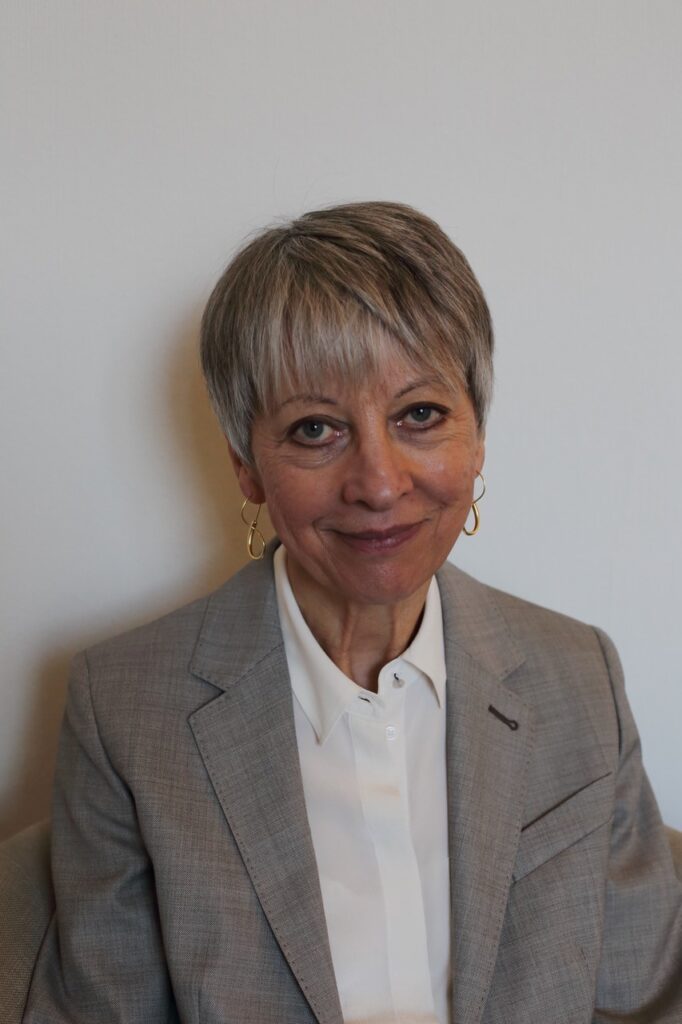
Susan Pacey has been a couple psychotherapist and psychosexual therapist for 30 years, with a private practice in central London and many years in the National Health Service (NHS).
Susan was awarded the degree of Doctor of Couple Psychotherapy by Tavistock Relationships and the University of East London in 2018 and is the author of the book, Sensate Focus and the Psyche – Integrating Sense and Sexuality in Couple Therapy (2024), based on her doctoral study. She also gained an MA in Psychoanalysis, Attachment and the Couple Relationship at Tavistock Relationships in 2010, having qualified in psychosexual therapy in the early 1990s.
Susan was on the editorial board of the journal, Sexual and Relationship Therapy, for several years. She has written academic papers on the medicalisation of sex; the impact of pregnancy and childbirth on sexual relationships; circumcision, female genital mutilation, gender reassignment and ethics; and step-parenting and sexuality, as well as reviews of books, films and poetry. Susan has been a teacher, speaker and chair at national and international professional conferences on many aspects of psychotherapy, sexuality, and sexual health.
Does the intervention ’sensate focus’ help integrate sexuality in couple psychotherapy?
The focus of my presentation is the key issues about working consciously and unconsciously with couples’ sexual relationships in the 21st century and the role the tactile intervention may play in helping clients achieve their emotional-relational goals.
Today it remains an enormous challenge to engage with professional differences of various paradigms and provide effective psychosexual services. Here I use the word ‘psychosexual’ in the broadest sense, meaning the psychological aspects of sex and sexuality as well as sexual behaviour and technique.
The body is a repository of unconscious experience and I propose that sensate focus taps these unconscious memories. After 30 years as a psychotherapist, I have learned that sensate focus is in reality not so much a cognitive-behavioural tool, but more a process. It is a process which is predominantly emotional-relational and developmental for couples, not a programme.
I will illustrate the comments above with case vignettes, linking the clinical material to Donald Winnicott’s celebrated concepts about preverbal experience, including the state of unintegration, embodiment, transitional space, holding, play, the capacity to be alone and ‘mirroring’.
May 26th, 8.00 – 9.30 p.m. CET
Linsey Blair “No sex, please, we’re parents”
To participate in the lecture go to
You can register untill May 26th
Linsey Blair has been a practicing sex and relationship therapist for over 10 years. Her original training in couple therapy was at Tavistock Relationships where she then went on to be staff. She was a clinical lecturer and co-lead of the psychosexual MSC at TR. She was also the lead psychosexual therapist at Croydon University Hospital, London. Linsey then relocated to Galway in 2018 where she created a team of psychosexual and couple therapists that work alongside clinical psychologists, physiotherapists and individual psychotherapists at Evidenced Based Therapy Centre. She is now teaching the psychosexual modules for the first couple training in Ireland in The Couples Institute, Cork and is a guest lecturer for Galway University. She publishes regularly and speaks at international conferences.

No sex, please, we’re parents
In this talk would like to focus on two issues concerning sexual intimacy in parental couple relationship. The first is a why question. Why is it that sexual intimacy takes such a hit when we become parents? The second is a how question. How do we work with this as clinicians?
The adjustment of the couple relationship when a baby comes along can be a difficult time for many parents. The period following the birth of the first baby is a time that many couples enter therapy. Traditionally, in psychoanalytic couple therapy, the clients’ physical and sexual transitions were often ignored in favour of the emotional consequences of parenting. However, the couple relationship must change and adapt both emotionally and sexually to accommodate a third into its dynamic, and the emotional and sexual tend to be intertwined.
In this talk I will be referring to a chapter I wrote for the book ‘Couples as Parents’ edited by Damian McCann and Kate Thompson. I encourage you to read it before attending the talk.
March 24th, 8.00 – 9.30 p.m. CET
James Poulton “Notes on the healing couple”
To participate in the lecture go to
You can register untill March 24th
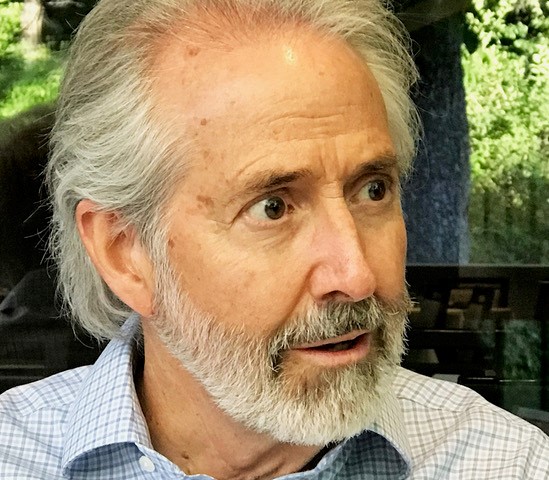
James Poulton, Ph.D., is a psychoanalytic psychotherapist in private practice in Salt Lake City, Utah, an Adjunct Assistant Professor in Psychology at the University of Utah, and an Emeritus national faculty member of the International Psychotherapy Institute (IPI). He is the co-founder of IPI’s Salt Lake City Chapter, and he currently serves as a member of IPI’s Faculty Development Committee and of the Steering Committee of IPI’s Psychoanalytic Psychotherapy Program. He is also one of three concurrent Editors-in-Chief of the journal, Couple and Family Psychoanalysis. He has written numerous articles and chapters on psychological treatment and theory, and is the author of Object Relations and Relationality in Couple Therapy: Exploring the Middle Ground (2012) and co-author of Suffering and Sacrifice in the Clinical Encounter (2020) and Internalization: The Origin and Construction of Internal Reality (2001). He has also co-authored two books on the history of art in the American West: LeConte Stewart: Masterworks (2012), and Painters of Grand Teton National Park (2015). His interests include skiing, music, philosophy, art, and the theory of the creative process.
Notes on the Healing Couple
How do the partners of a couple help each other heal from wounds, conflicts, and traumas, both past and present? What mechanisms are relied upon to move them from the narcissistic, omnipotent positions they occupy when entering treatment to a shared position from which each not only helps the other re-claim projections and metabolize past injuries, but also aims to ensure the psychological health and creative growth of both partners and of the relationship? In analytic literature, many models have been advanced to describe evolutions such as this, and to conceptualize the functioning of healthy couples. In this paper, I would like to examine one of the most developed of these models – Morgan’s theory of the “creative couple”– and highlight where I believe it does not quite explain some of the fundamental characteristics of what I will call the “healing couple.”
My central thesis: I believe the healing couple exhibits a dimension of personal and interpersonal experience that prior theories have either overlooked or underemphasized. This dimension, a form of shared creativity, is comprised of several interrelated components, including: (1) a shared state of mutual psychic co-existence, in which the boundaries between self and other are fluid, facilitating an immediacy of knowing each other that cannot be explained via empathy or conscious learning; (2) a shared capacity to listen into and elaborate not only upon each partner’s own unconscious states but those of the other partner and of the shared unconscious of the relationship itself – essentially, a couple-based version of the form of creativity Winnicott described for individuals; and (3) a shared ability to replace, if only intermittently, narcissistic modes of relating, in which each aggressively and omnipotently asserts the accuracy of their projections, with a commitment to strengthening the couple via the discovery and elaboration of the real foundations of the relationship.
2024
November 30th, 9.30-11.00 a.m. CET
Dr Judith Pickering “Harmony of the spheres: musical elements of couple communication”
To participate in the lecture go to
REGISTER AND PAYYou can register until November 27th.